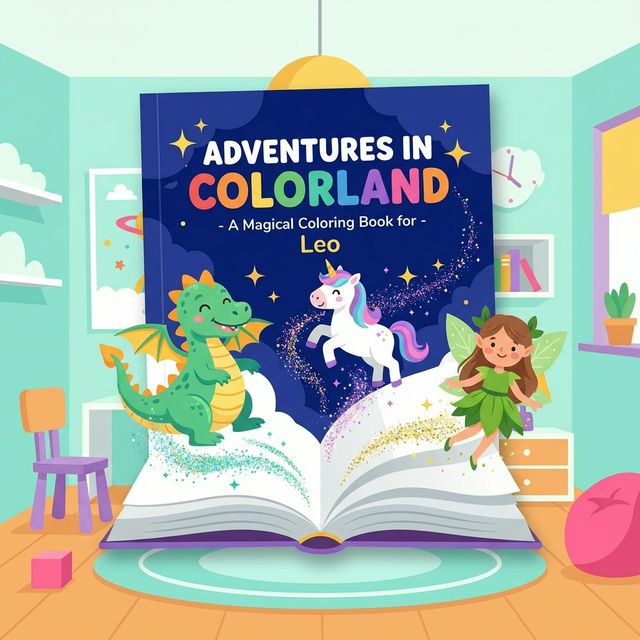
How to Personalize a Coloring Book
for Your Child
A generic coloring book gets used for a week. A coloring book with a child's name on the cover, their favorite animal on every page, and a theme built around what they love right now? That one gets carried everywhere. Here's exactly how to make it.
There's a gap between a coloring book a child receives and a coloring book a child treasures. The difference almost always comes down to one thing: how much of it feels like it was made specifically for them.
This isn't about expensive custom printing or complicated design software. Personalization works at several levels — from something as simple as writing their name on the cover, to something as involved as building a complete themed book around their current obsession. This guide covers all of it, from the quick wins you can do in five minutes to the more involved options for gifts that genuinely land.
Why Personalization Works So Well
Children between ages 3 and 10 are in the middle of forming their sense of identity. They're figuring out who they are — what they like, what they're good at, what makes them different from other people. Anything that reflects their specific identity back at them gets their attention in a way that generic content simply can't.
A coloring book full of unicorns is nice. A coloring book full of unicorns with "Sofia's Coloring Book" on the cover and Sofia's name worked into the first page is something Sofia will show every adult she sees for the next three days.
That engagement isn't superficial. A child who feels ownership over their coloring book colors more, colors more carefully, and develops stronger fine motor skills and creative confidence as a result. The personalization is the hook — the developmental benefit is the payoff.
Level 1 — The Name (5 Minutes)
The simplest and most effective personalization is also the fastest: get the child's name onto the book and onto at least one page inside it.
For the cover, a Sharpie on the front works fine for a book you already have. But for something that looks genuinely designed, the KikoPop Name Sticker Maker generates a custom name outline in the child's choice of font — instantly, free, no account needed. Print it, cut it out, and glue or tape it to the cover. Takes five minutes and transforms how the book feels to the child.
Free: Name Sticker Maker
Type any name, pick from 30 kid-friendly fonts, download a transparent outline PNG. Print it for a cover label or use it as a coloring page on its own.
Make a Name Sticker →The name outline PNG also works as a standalone coloring activity — print it large, let the child color in the letters of their own name. For children ages 4–7, this is often more engaging than a standard coloring page because the subject is inherently interesting to them.
Level 2 — The Theme (20 Minutes)
Once you have the name sorted, the next level is theme selection. Most children between 3 and 9 have a current obsession — an animal, a character type, a setting, or an aesthetic — that completely dominates their attention for months at a time. Building a coloring book around that obsession produces a completely different level of engagement than a generic mixed-theme book.
Common high-engagement themes by age:
- Ages 3–5: Dinosaurs, cats and dogs, farm animals, simple flowers, vehicles, basic fantasy (dragons, fairies)
- Ages 5–7: Specific animal species (axolotls, red pandas, sharks), mermaids, space, horses, dogs by breed
- Ages 7–10: Fantasy creatures, manga-style animals, nature scenes, architecture, patterns and mandalas
Once you have the theme, assembling a themed coloring book is a matter of collecting pages that fit it. KikoPop's character and background packs are organized by theme and licensed for printing — you can assemble a complete 20-page themed book from a single pack download.
Browse KikoPop Character Packs
Themed character collections — 10 illustrations per pack, print-ready, licensed for personal and classroom use. Mix and match themes to build the perfect book.
Browse Character Packs →Level 3 — The Composed Page (30–45 Minutes)
This is where personalization becomes genuinely impressive. A composed page is one where you've placed the child's name, a character they love, and a background or setting into a single custom coloring page — designed specifically for them.
The KikoPop Composer is the tool for this. It's a free browser-based layer editor that lets you:
- Upload any background image (a frame, a border, a scenic backdrop)
- Layer character images on top of it
- Add word art with the child's name in a custom font and style
- Adjust the position, size, opacity, and rotation of every element
- Export the finished page as a 300dpi PNG or PDF — print-ready
A complete personalized page takes about 15–20 minutes the first time. Once you have the layout you like, generating variations (different characters, same name and background) takes about 2 minutes per page. A 10-page personalized coloring book is a realistic one-evening project.
Free: KikoPop Composer
Layer backgrounds, characters, and name art onto a canvas. Export at 300dpi. No design experience needed — works in your browser.
Open Composer →Assembling and Printing the Book
Once you have your pages, you have a few options for the physical book depending on your budget and how polished you want the result:
Home printing + spiral binding: Print at home on standard copy paper (20lb is fine for crayons, 24lb for markers). Take the stack to any office supply store and ask for spiral binding — it costs $3–6 and produces a book that opens flat, which children strongly prefer over stapled or glued bindings. This is the fastest and most affordable option.
Home printing + report cover: A clear-front report cover from any office supply store gives the book a professional look without any binding service. Costs about $1. The clear front means the custom cover page shows through — which is the whole point.
Print-on-demand service: Sites like Lulu, Blurb, or Mixam will print and bind a custom book from a PDF you upload. Quality is genuinely excellent — the result looks like a commercially published book. Turnaround is typically 5–7 days. Cost for a 20-page saddle-stitched book starts around $8–12 plus shipping. For a birthday or holiday gift this is the premium option.
Adding Activity Pages
A coloring book with a few activity pages mixed in holds attention longer than pure coloring. For a personalized book, activities tied to the theme make the whole thing feel more cohesive:
- A name tracing page at the front — the child traces their own name as the first activity. Sets the "this is mine" tone immediately. Generate one free with the Trace & Write Generator.
- A themed maze — generate a maze with the child's name as the title. "Navigate the DRAGON maze, Emma!" takes 30 seconds in the Maze Generator and adds meaningful variety to the book.
- A "color by number" style page — any coloring page can become a simple color-by-number by writing numbers in the sections and providing a key. Takes two minutes with a pen and adds a game-like element older children enjoy.
- A blank "draw your own" page — a page with just a simple frame border and "Draw your own [theme]!" as a prompt. Children often spend more time on this page than any other.
Making It a Gift
If this is for a birthday or holiday, a few finishing touches move it from "nice" to "memorable":
- A dedication page — inside the front cover, handwrite a short dedication. "For Mia, who loves dragons more than anyone. Happy 6th Birthday. Love, Grandma." This takes 30 seconds and is often the part the child re-reads most.
- A "this book belongs to" page — children love ownership markers. A simple first page with a decorative border and a line for their name gives them something to fill in themselves.
- Pair it with supplies — a personalized coloring book paired with a fresh set of colored pencils or a new pack of fine-tip markers is a complete gift that requires nothing else. Budget $10–15 for a good colored pencil set and the total gift cost is still under $25 for something genuinely one-of-a-kind.
The Bottom Line
Personalization doesn't require expensive tools or hours of work. At its simplest, it's a name on the cover and a theme the child loves. At its most involved, it's a fully composed custom book with their name worked into every page.
The KikoPop tools cover every level of that spectrum — all free, all usable without design experience, all designed to produce print-ready output you can have in your hands the same day.
Start with the Name Sticker Maker for the quick win. If you want to go further, the Composer is where the real magic happens.