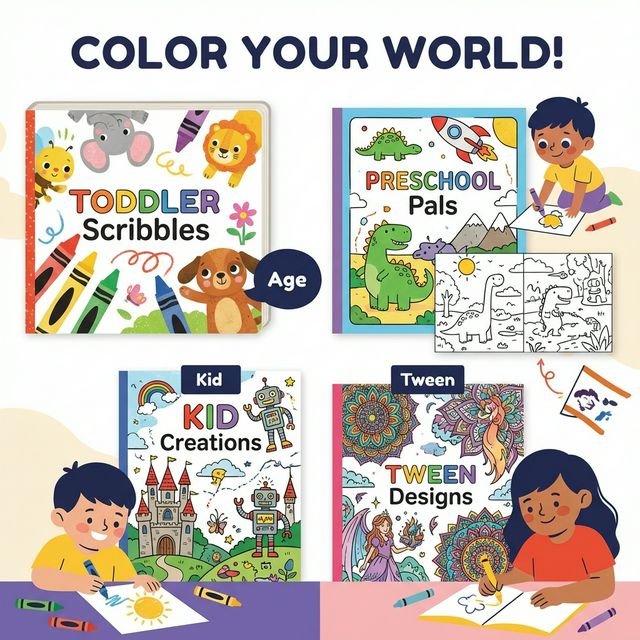
The Best Coloring Books for Kids by Age
What Actually Keeps Them
Engaged
Not all coloring books are equal. The complexity, line weight, and subject matter that delights a 3-year-old will frustrate a 10-year-old — and vice versa. Here's exactly what to look for at every stage.
Every parent has been there: you buy a beautiful coloring book, your child opens it, colors half a page, and never touches it again. It's not that they don't like coloring — it's that the book wasn't right for their age and stage.
Coloring is genuinely one of the best screen-free activities for children. It builds fine motor control, develops focus and patience, and gives kids a quiet creative outlet that's entirely their own. But only if the book matches where they actually are developmentally.
Here's the complete guide to what works at every age, what to avoid, and what to look for when you're buying.
Why Age Matching Actually Matters
Coloring book design involves dozens of deliberate choices: line thickness, image size, subject complexity, background density, and the amount of white space inside each shape. A book designed well for a 4-year-old has thick outlines, large shapes, minimal background detail, and subjects a toddler recognizes instantly — big cats, simple flowers, cartoon faces.
A book designed for a 10-year-old has fine lines, intricate patterns, detailed backgrounds, and the kind of complexity that rewards patience and concentration. Hand that book to a 4-year-old and you'll get frustration, torn pages, and a child who thinks they're "bad at coloring." Hand the simple book to a 9-year-old and you'll get boredom within 90 seconds.
Ages 2–3: Big, Bold, and Forgiving
At this age, the goal isn't precision — it's exploration. Two and three-year-olds are still developing the grip strength and hand-eye coordination needed to stay inside any lines at all. The best coloring books for toddlers work with this rather than against it.
What to look for:
- Very thick outlines — 3px or heavier. The thicker the line, the more forgiving it is when the crayon wanders.
- Large, simple shapes — a whole page for one big animal face, not a detailed scene with multiple small elements.
- Familiar subjects — dogs, cats, simple flowers, suns, basic vehicles. Toddlers color most enthusiastically when they recognize exactly what they're looking at.
- Minimal or no background detail — pure white space around the main subject is ideal.
- Thick paper — crayons are the right tool at this age and thick paper prevents bleed-through.
What to avoid: Any book marketed as "coloring" that contains small pattern sections, fine lines, or detailed backgrounds. These are designed for adults or older children and will produce nothing but frustration.
Ages 4–5: Ready for Slightly More
Preschool and PreK kids have meaningfully better motor control than toddlers. They can hold a crayon or colored pencil with a proper grip, they can follow a line with reasonable accuracy, and they're starting to understand color theory in a basic way ("the sky should be blue, the grass should be green").
This is also the age where personalization starts to matter enormously. A coloring page with their name on it — or featuring their favorite animal — will get far more engagement than a generic page.
Free: Make a Personalized Name Coloring Sheet
The KikoPop Name Sticker Maker lets kids type their name, pick a fun font, and download a custom outline PNG — perfect for a personalized coloring page.
Try It Free →What to look for:
- Moderately thick outlines — thinner than toddler books but still clearly defined
- Simple scenes with 2–3 elements per page (an animal in a setting, for example)
- Subjects tied to their current interests — whatever phase they're in (dinosaurs, princesses, construction vehicles)
- Small reward details — stars, hearts, simple patterns inside a shape they've already colored
Ages 6–8: The Sweet Spot
This is the golden age for coloring books. Kids at this stage have real fine motor control, genuine attention spans, emerging patience, and strong opinions about what they like. They can follow detailed lines, work on a page across multiple sessions, and feel genuine pride in a finished piece.
They're also old enough to use colored pencils properly — which opens up a whole new level of blending, shading, and color mixing that crayons can't achieve.
What to look for:
- Character-based coloring — animals with personality, fantasy creatures, playful scenes with multiple characters
- Moderate background detail — enough to make the page feel complete when finished, not so much that it overwhelms
- Variety within the book — a mix of complex pages and simpler ones so kids can choose their challenge level on any given day
Browse KikoPop Coloring Books
Our character collections are designed specifically for the 6–10 age range — bold outlines, intricate interior patterns, and subjects kids actually want to color.
Shop Coloring Books →Ages 9–12: Complexity and Creative Control
Tweens are a challenging audience. They're old enough to find "kids' coloring books" babyish but not necessarily ready for pure adult mandala-style complexity. The sweet spot is detailed character art — intricate patterns, full scenes, and imagery that rewards real effort and time.
At this age, kids also respond strongly to genre and aesthetic. A 10-year-old who loves fantasy won't touch a coloring book full of woodland animals, and vice versa. Subject match matters more than ever.
What to look for:
- Fine-line artwork with high detail density
- Genre-specific themes (fantasy, animals, nature, geometric patterns)
- Full-page compositions where the background is as detailed as the foreground
- Books that work equally well with colored pencils, fine-tip markers, or gel pens
Quick Reference: Age Guide at a Glance
| Age | Line Weight | Complexity | Best Tools | Key Feature |
|---|---|---|---|---|
| 2–3 | Very thick | Single large shape per page | Chunky crayons | Forgiving lines, familiar subjects |
| 4–5 | Thick | Simple scenes (2–3 elements) | Crayons, large markers | Personalization, current interests |
| 6–8 | Medium | Characters with interior detail | Colored pencils, crayons | Variety, character personality |
| 9–12 | Fine | Full-page detailed scenes | Colored pencils, gel pens, markers | Genre match, high complexity |
One More Thing: The Classroom Angle
If you're a teacher reading this — everything above applies to classroom use, but with an additional consideration: licensing. Many free coloring pages found online are not licensed for classroom reproduction. Printing 25 copies of a page you found on Pinterest is technically a copyright violation, even if it feels harmless.
KikoPop coloring pages are explicitly licensed for classroom use. When you purchase a pack, you can print as many copies as your class needs for the duration of the school year — no grey areas.
We also have a free tool specifically for teachers:
Free: Trace & Write Generator
Generate custom trace-and-write worksheets for any word list. Dashed vector letters, 3 difficulty levels, print-ready PDF. Free desktop download.
Get Free Tools →The Bottom Line
The best coloring book for a child is the one that meets them where they are — not the one that looks most impressive on the shelf. A perfectly age-matched book will get used. A beautiful but mismatched book will sit untouched after the first frustrated session.
Use the quick reference table above as your guide. When in doubt, go slightly simpler rather than slightly more complex — a child who feels successful will color more, and the motor control and patience that more complex books require will come naturally with time.
And if you want a coloring book that genuinely holds up at the 6–10 sweet spot, browse the KikoPop collection — every book is designed with exactly these principles in mind.