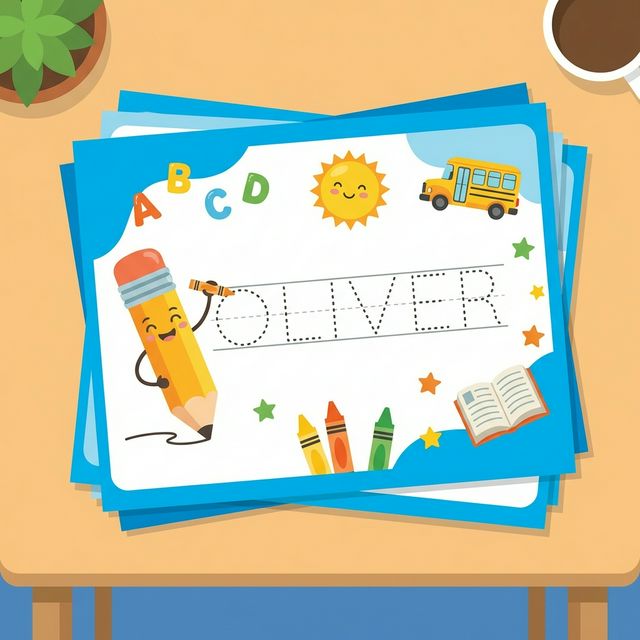
Free Name Tracing Worksheets
Customize for Any Child's Name
A child's own name is the single most motivating thing you can put on a tracing worksheet. Here's how to generate personalized name tracing sheets for every student in your class — in minutes, not hours.
Ask any PreK or Kindergarten teacher what their students are most eager to learn to write, and the answer is almost always the same: their own name. Before they care about writing "cat" or "dog" or any sight word, they want to write their name. It's the first piece of written language that feels personal and meaningful to them.
That motivation is a gift — and name tracing worksheets are one of the best ways to channel it into real handwriting development. The problem has always been logistics: generating a personalized worksheet for every child in a class of 20 or 25 is genuinely tedious when you're doing it one at a time.
This guide covers everything you need to know about name tracing — what makes a good worksheet, how to match difficulty to the child, and how to generate custom sheets for your whole class without spending your evening on it.
Why Name Tracing Works So Well
Handwriting development in early childhood follows a predictable sequence. Children first learn to make controlled marks (scribbling with intention), then copy simple shapes, then trace over letter models, and finally write letters from memory. Tracing is the critical bridge between copying and independent writing.
Name tracing works especially well for three reasons:
- Intrinsic motivation — children are inherently invested in their own name. They'll practice it more willingly and more repeatedly than any other word.
- Immediate recognition — they can self-check. They know what their name looks like, so they can tell when their tracing matches the model and when it doesn't.
- Mixed letter forms — most names contain a natural mix of letters with different stroke patterns. "Sophia" gives you a capital S, a tall letter, a round letter, a descender, and more — all in one short word.
What Makes a Good Name Tracing Worksheet
Not all tracing worksheets are created equal. The quality of the worksheet directly affects how much fine motor benefit a child gets from the activity. Here's what separates effective worksheets from filler:
Dashed or dotted letter guides, not solid grey letters. Tracing over a solid light-grey letter teaches children to color inside lines, not to form letters. Proper tracing worksheets use dashed lines that show the shape of the letter while requiring the child to actively construct the stroke — which is what builds muscle memory.
Correct letter sizing. Letters should be large enough for small hands but not so large that a single letter requires multiple arm movements. For PreK, letters around 1.5–2 inches tall are appropriate. For Kindergarten, 1–1.5 inches is the target.
Multiple repetitions on the same sheet. A single tracing pass doesn't build much. The best worksheets include 3–5 tracing lines of the same name so children get genuine repetition without switching worksheets.
Clean, uncluttered design. Backgrounds, decorations, and clipart around the tracing lines are a distraction for young children. The worksheet should direct all attention to the letters.
Free: Name Sticker Maker
Type any name, pick from 30 kid-friendly fonts, and download a transparent outline PNG instantly. Works on any device — no account needed.
Try Name Sticker Maker →Matching Difficulty to the Child
Name tracing isn't one-size-fits-all, even within a single classroom. A child who entered PreK already able to hold a pencil correctly needs a different challenge than a child still developing their grip. Here's how to think about it:
Beginning level (ages 3–4, early PreK): Large letters, wide dashes with lots of space between them, starting dots to show where each stroke begins. The child's job is just to connect the dots in the right direction.
Intermediate level (ages 4–5, PreK/early Kindergarten): Medium letters, standard dashed lines, starting dots present but less prominent. The child needs to follow the dashes without as much scaffolding.
Advanced level (ages 5–6, Kindergarten): Smaller letters, fine dashed lines, no starting dots. The child is close to independent writing and just needs the model for reference.
The Whole-Class Workflow Problem
Here's where most teachers hit a wall. Creating a custom worksheet for one child is easy. Creating 25 different worksheets — each with a different name, possibly at different difficulty levels — is where the evening disappears.
The traditional approaches all have problems:
- Hand-lettering worksheets — beautiful but time-consuming. An hour of teacher time per batch minimum.
- Generic "fill in the name" templates — the font and sizing are fixed, you can't adjust difficulty, and they often look like clipart from 2005.
- Paid worksheet generator subscriptions — monthly fees add up, and many generate PDF files that can only be printed at fixed sizes.
The KikoPop approach splits the problem in two tools that together cover both use cases:
Free: Trace & Write Generator
Desktop app that generates full trace-and-write worksheets with dashed vector letters, 3 difficulty levels, optional scene image, and 5 writing practice lines. Print-ready PDF output. Works offline.
Download Free (Windows) ↓Uppercase First or Lowercase First?
This is one of the most common questions teachers ask, and the answer depends on your school's handwriting curriculum — but here's the practical reality:
Most children learn their name with a capital first letter and lowercase for the rest (Emma, not EMMA or emma). This is the convention in most English-language PreK and Kindergarten programs, and it's what children see on their cubbies, name tags, and books.
Starting with this mixed-case format is almost always the right call because it matches the real-world version of their name they've already internalized. Switching to all-caps or all-lowercase later is easy. Starting with the format they already recognize removes one layer of confusion from the learning process.
Beyond Names: What Else to Trace
Once children have their own name down, tracing worksheets extend naturally to:
- Sight words — the Dolch and Fry lists are the obvious targets. Tracing "the", "and", "is" builds the same muscle memory as names.
- Vocabulary from current units — if you're doing a unit on animals, tracing "cat", "dog", "fish" connects handwriting practice to content learning.
- Children's own addresses or phone numbers — practical life skills that parents appreciate and that give children a sense of ownership.
- Classmates' names — a wonderful community-building activity for late Kindergarten. Children learn each other's names in written form and practice writing for an authentic audience.
The Trace & Write Generator handles all of these — any word or short phrase becomes a worksheet with the same dashed vector letters and difficulty controls.
Pairing Tracing with Coloring
One of the most effective early literacy activities combines name tracing with a coloring component on the same sheet. Children trace their name, then color a related image — creating a finished product they're proud to take home.
This matters for two reasons. First, it extends the fine motor session beyond just the tracing repetitions, building stamina. Second, it gives children a tangible finished product — which drives the intrinsic motivation to do it again tomorrow.
The Trace & Write Generator includes an optional scene image area for exactly this purpose. Upload any coloring image and it appears as a faded tracing guide above the writing lines — so children can color the scene and trace the name on the same print.
Browse KikoPop Character Packs
Printable character illustrations designed to pair with worksheets. Licensed for classroom printing — no copyright concerns.
Browse Character Packs →Printing Tips for Best Results
A few practical notes that make a big difference in the finished product:
- Print at 100% scale, not "fit to page." Fitting to page compresses the letters and makes the dashes too small for small hands to follow accurately.
- Use at least 20lb paper for pencil tracing. Standard copy paper works fine. For marker or crayon tracing, 24lb prevents bleed-through.
- Black ink only is fine — the dashed lines don't need to be grey. High-contrast black dashes are actually easier for young children to follow than light grey ones.
- Laminate the first copy of frequently-used name sheets. Children can trace with a dry-erase marker, wipe, and repeat — saving paper and giving more repetition per sheet.
The Bottom Line
Name tracing worksheets are one of those rare classroom tools that check every box: developmentally appropriate, intrinsically motivating, directly tied to real literacy outcomes, and easy to differentiate. The only thing that's ever made them impractical is the time cost of generating personalized versions for every child.
The two free KikoPop tools solve that. The Name Sticker Maker generates a custom name outline PNG in about 30 seconds — type the name, pick a font, download. The Trace & Write Generator builds a full print-ready worksheet with dashed letters, difficulty controls, and optional coloring scene.
Both are free, both work offline once installed, and neither requires an account. Your whole class can have personalized worksheets before the end of your prep period.