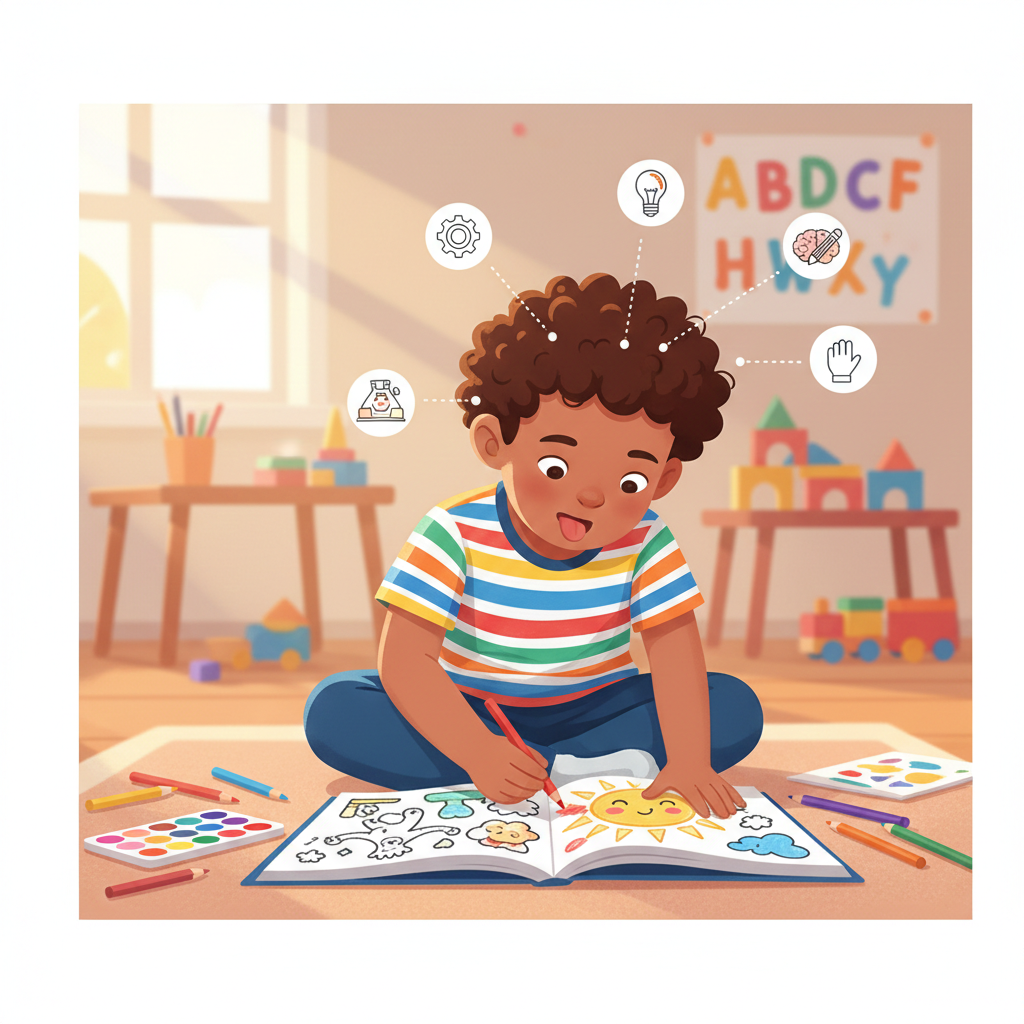
Coloring for Kids
The Surprising Benefits for Focus, Creativity & Fine Motor Skills
Coloring looks like a simple quiet activity. Underneath that quiet, a child's brain and hands are doing something genuinely complex — and the developmental payoff is larger than most parents realize.
The screen time debate has made parents acutely aware of what their children are consuming digitally. It's also created a blind spot in the opposite direction: screen-free activities often get credit for merely being screen-free, without examining what they actually develop. Coloring deserves better than that — it has a real, documented developmental profile that parents should understand, because that understanding changes how you use it.
Fine Motor Development
Fine motor skills are the controlled, precise movements of the hands and fingers. They develop throughout early childhood and are prerequisites for everything from handwriting to using scissors to eventually typing. The specific movements required for coloring — holding an implement with a pincer or tripod grip, controlling pressure, staying within boundaries, and varying stroke direction — are precisely the movements that build fine motor competence.
What makes coloring particularly effective for fine motor development compared to other activities is the combination of sustained duration and continuous feedback. A child who colors a page spends 10-30 minutes making hundreds of small controlled movements in a row — far more fine motor repetitions per session than most other structured activities. The feedback is immediate and visual: the child can see when their strokes go outside the lines and self-correct in real time.
Occupational therapists routinely recommend coloring as a fine motor intervention for children who are developing behind peers. It's effective precisely because children engage willingly — the motivation to finish a picture they find engaging produces far more practice time than any structured exercise.
Focus and Sustained Attention
Sustained attention — the ability to maintain focus on a single task for an extended period — is one of the cognitive skills most consistently correlated with academic success and it's one that many parents worry is deteriorating with increased screen exposure.
Coloring builds sustained attention in a way that's structurally different from most other activities. It doesn't provide the constant novelty and stimulation that digital media delivers. It requires the child to generate their own engagement within a constrained creative space. This is actually a feature: the brain's capacity for sustained self-directed attention grows through practice, and coloring provides that practice in a form children accept willingly.
The duration a child will color before disengaging increases as they develop — from about 5-8 minutes at age 3 to 20-45 minutes at age 7-8. That progression tracks closely with general attention development and can be used as a rough attention benchmark by parents who observe it over time.
Creativity and Color Decision-Making
The coloring page provides structure. What a child does within that structure is creative decision-making — which colors to use, how to handle adjacent sections, whether to use a realistic palette or an imaginative one, how to add detail or pattern within a shape. These decisions are genuine creative choices and they compound over thousands of coloring sessions into a developing aesthetic sense and creative confidence.
Children who color regularly tend to develop stronger color vocabulary (because they name colors while working), more adventurous color choices over time (because they experiment with results they can see immediately), and greater tolerance for creative process — the understanding that a finished creative work takes sustained effort and patience.
The creative development from coloring transfers to drawing. Children who color extensively tend to draw with more color variety, more intentional composition, and more confidence than children who don't — because they've spent thousands of minutes making color and composition decisions in a lower-stakes format.
Stress Reduction and Emotional Regulation
Coloring has documented stress-reducing effects in adults — the effect has been studied extensively in the context of adult coloring books and mindfulness practice. The mechanism is straightforward: repetitive, controlled movement with a clear and achievable goal activates the parasympathetic nervous system (the "rest and digest" system) and suppresses the stress response.
In children, this effect is even more pronounced because children have less developed emotional regulation capacity and more readily enter the flow state that coloring produces. A child who is upset, overstimulated, or anxious will often calm significantly in 5-10 minutes of coloring — not because they've processed the underlying emotion, but because the activity provides genuine physiological regulation that makes processing possible afterward.
Many parents and teachers use coloring as a regulation strategy without fully understanding why it works. Understanding the mechanism helps: it's not distraction, it's active parasympathetic activation. That's a meaningful distinction when you're deciding how to support a child through a difficult emotional moment.
The Literacy Connection
The connection between coloring and literacy development isn't obvious, but it's real. Coloring builds the visual discrimination skills that reading requires — the ability to distinguish between similar shapes (which underlies letter recognition), track boundaries between areas (which underlies word spacing awareness), and maintain directional movement (which underlies left-to-right reading orientation).
Children who have done extensive coloring before formal reading instruction tend to have stronger letter recognition — not because they've learned letters from coloring pages, but because the underlying visual processing skills that distinguish "b" from "d" from "p" have been exercised extensively through coloring.
What This Means Practically
Understanding the developmental profile of coloring changes how you provide it. A few practical implications:
- Age-appropriate complexity matters. A page that's too simple for the child's fine motor level provides insufficient challenge — they finish it without the sustained attention engagement that produces developmental benefit. A page that's too complex produces frustration. Match the complexity to the child's current level.
- Unstructured coloring time is different from instructional coloring. Both are valuable but they serve different functions. Free coloring for pleasure builds creativity, regulation, and intrinsic motivation. Instructional coloring connected to academic content builds vocabulary, comprehension, and content retention. Use both.
- The media matters less than the engagement. Crayons, colored pencils, markers, and watercolors all produce developmental benefit. The variation in media is actually good — different tools require different grip adjustments and pressure responses, building more robust fine motor versatility than a single medium.
Shop KikoPop Coloring Books
Age-matched complexity, consistent art style, classroom licensing included. Every book designed with developmental appropriateness in mind.
Shop Coloring BooksBottom Line
Coloring is worth investing in deliberately — not just as a quiet-time filler, but as a genuine developmental tool. The fine motor, attentional, creative, emotional, and pre-literacy benefits are real, documented, and practically significant. The best coloring books and pages aren't the prettiest or the most thematic — they're the ones age-matched to produce genuine engagement at the child's current developmental level.