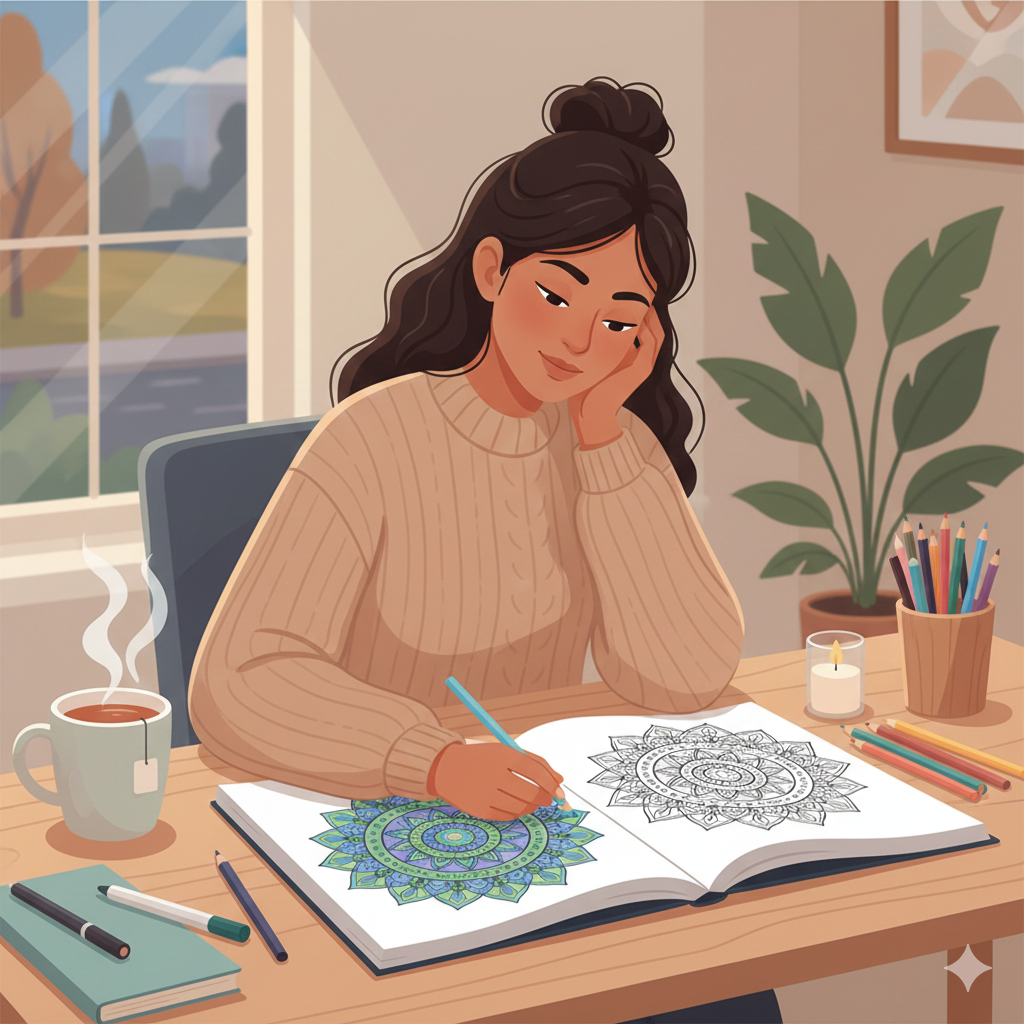
Adult Coloring Books: Why They Actually Work for Stress Relief
And the Science Behind It
Adult coloring books had a moment in 2015 and then got dismissed as a fad. The research that came out after the fad settled tells a more interesting story. Here is what the science actually says about why coloring works — and what that means for choosing a book that delivers the effect.
When adult coloring books became a cultural phenomenon around 2015, the response ranged from enthusiastic adoption to skeptical dismissal. Publishers rushed out titles, sales peaked, and then the conversation mostly moved on. What got left behind was a growing body of research conducted after the peak that examined what was actually happening in the brain during coloring — and the results are more substantive than either the hype or the backlash suggested.
What the Research Actually Shows
Several published studies have examined coloring's effects on anxiety and stress markers. The consistent finding: structured coloring activities — particularly geometric patterns like mandalas — produce measurable reductions in anxiety compared to both free-form drawing and non-creative activities. A 2005 study by Curry and Kasser published in Art Therapy found that coloring mandalas reduced anxiety significantly more than coloring on a blank page or coloring a plaid pattern.
The mechanism appears to involve what researchers call "attentional focus narrowing." Coloring within a structured pattern requires enough cognitive engagement to occupy the default mode network — the part of your brain that generates rumination, worry, and self-referential thinking when not directed to a task. But coloring does not require enough cognitive load to be stressful itself. It sits in a narrow band that occupies the mind without taxing it.
This is functionally similar to what happens during meditation and flow states, and it produces a similar outcome: the physiological markers of stress (cortisol, heart rate, muscle tension) decrease, and subjective feelings of calm increase.
Why Screens Do Not Produce the Same Effect
Digital coloring apps exist and are popular, but they do not appear to produce the same stress reduction as physical coloring. The likely reasons are practical rather than mystical. Physical coloring involves tactile feedback (the texture of paper, the drag of a pencil), fine motor engagement that occupies the hands at a level screens do not match, and the absence of notifications, links, and the general hyperconnectivity of digital devices.
Physical coloring is also inherently screen-free, which for many adults represents a meaningful break from the primary source of their cognitive overload. The activity creates a natural boundary: you are doing something that cannot be interrupted by a notification because it is happening on paper.
What Makes a Book Effective for Stress Relief
Not all coloring books produce the stress relief effect equally. Based on the research, the features that matter are:
Structured complexity at the right level. Too simple (large shapes, minimal detail) and the mind is not occupied enough to stop ruminating. Too complex (microscopic detail, confusing compositions) and the activity becomes frustrating rather than calming. The sweet spot is moderate complexity — enough detail to engage attention fully, not so much that completing a section feels impossible.
Geometric or nature-based patterns. Mandalas, botanical illustrations, architectural patterns, and abstract geometric designs consistently outperform character-based coloring for adults specifically. The radial or repeating structure seems to be the functional element rather than the specific subject matter.
Good paper quality. Thin paper that bleeds through with markers creates frustration that counteracts the relaxation effect. Heavier paper (at least 90gsm, ideally 120gsm) allows the use of a wider range of tools and makes the coloring experience genuinely pleasurable rather than requiring careful pencil-only technique.
Single-sided printing. Pages printed on both sides cannot be colored with anything wet without destroying the reverse page. Single-sided pages allow markers, watercolor pencils, and blending tools, which significantly expand the creative possibilities and the depth of engagement.
Choosing the Right Book for Your Purpose
The research points to mandalas and geometric patterns for maximum stress-relief effect. But sustained engagement matters too — a book you find beautiful and want to return to will produce more cumulative benefit than a technically "optimal" book you find boring. Here is how to navigate the choice:
For anxiety and stress relief as the primary goal: Choose a mandala or geometric pattern book with moderate complexity. Avoid character or narrative-based books for this purpose.
For creative enjoyment with relaxation as a side effect: Botanical illustrations, fantasy landscapes, and architectural drawings all work well. The creative engagement produces flow states that carry similar benefits to targeted stress-relief coloring.
For a gift where you are not sure of the recipient's preference: Botanical or nature-based designs have the broadest appeal and hit the research's effective pattern types without requiring the recipient to be a mandala enthusiast.
KikoPop Adult Coloring Books
Geometric patterns, mandalas, and botanical designs. Single-sided printing on 90gsm paper. Designed for the full range of coloring tools.
Browse Adult Coloring BooksThe Tools Matter More Than People Think
For adult coloring specifically, tool quality meaningfully affects the experience. The most common mistake is using cheap colored pencils that are too waxy to blend and too light to produce saturated color. A mid-range set of colored pencils (Prismacolor, Faber-Castell Polychromos) transforms the activity compared to basic student pencils.
For mandala and geometric coloring specifically, fine-tip markers (0.3–0.5mm Microns or Stabilo point 88s) allow precise work in detailed sections that broader tools cannot reach. Many experienced adult colorists use a combination: markers for fine detail sections, colored pencils for larger areas and blending.
How to Actually Start and Keep Going
The most common reason adults stop coloring after buying a book is the blank-page paralysis of "I do not want to mess up a beautiful page." Two things help: start on a page that is not your favorite, and accept that any mark you make is reversible with colored pencil and mostly irreversible with marker. The acceptance of impermanence is itself a stress-reduction exercise.
A realistic starting session is 20 minutes. Set a timer, choose a section of a page (not the whole page), and color only that section. Finishing a small area is more satisfying than abandoning a half-colored full page, and completion is what drives the habit loop that brings you back tomorrow.
Bottom Line
Adult coloring books work for stress relief for the same reason that meditation and flow-state activities work: they occupy the mind fully enough to stop rumination without taxing it enough to cause their own stress. The research is clear on mandalas and geometric patterns as the most effective format. The rest is personal preference — find a subject you find beautiful, get decent colored pencils, and give it 20 minutes. The effect is real and it accumulates with consistent practice.