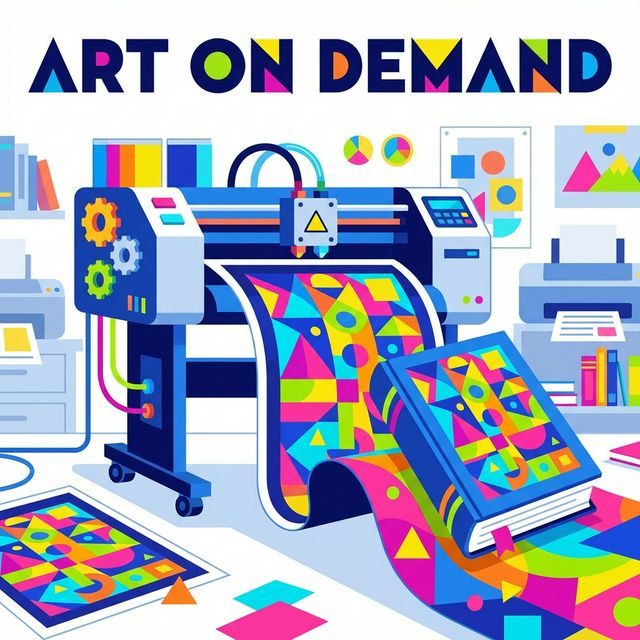
Geometric Abstract Art for Print on Demand
A Beginner's Guide
Geometric and abstract art is the single most beginner-accessible category in print-on-demand. It doesn't require drawing ability, it scales to any product size without quality loss, and the demand for distinctive abstract prints is consistent year-round.
Print-on-demand art selling has a reputation for being saturated. The abstract and geometric niche specifically is one of the few areas where that reputation doesn't hold — because the variety of possible designs is essentially infinite, the production cost is zero (no physical inventory), and buyers in this space are less price-sensitive than buyers in character-driven or novelty niches.
This guide covers what actually sells in geometric abstract POD, what tools produce the best results, and how to build a catalog without a design background.
What Actually Sells in Geometric Abstract POD
The abstract art market on POD platforms splits into a few distinct sub-categories with different buyer behaviors. Understanding which sub-category you're targeting changes what you design.
Minimalist geometric prints. Clean shapes, limited color palettes (2-4 colors), strong negative space. This is the most consistently selling sub-category because it matches the dominant interior design aesthetic in the target buyer demographic (25-45, urban or suburban, Scandinavian-influenced home decor). The designs look simple but require strong color instinct and proportion judgment.
Mandala and symmetrical patterns. High-detail symmetrical designs that reward extended viewing. Strong on canvas prints and phone cases. The buyer is often also a coloring book buyer — there's meaningful crossover between the coloring book and mandala art print markets.
Color field and abstract expressionist prints. Fluid, organic abstract forms using bold or gradient color. Strong for large format canvas prints. This category has the most distinctive pricing — buyers pay premium prices for abstract pieces that feel original and one-of-a-kind, even from a POD seller.
Geometric pattern repeating tiles. Patterns that tile seamlessly — used on fabric, wallpaper, phone cases, tote bags. These require slightly different design thinking (seamless repeat construction) but the demand is very high and the use cases extend far beyond wall art.
Tools for Generating Geometric Abstract Art
The KikoPop Abstract Art Generator is a desktop application built specifically for generating print-ready geometric abstract art. It uses algorithmic generation with seeded randomness — meaning you can produce thousands of unique variations from a single style preset, or lock in a specific seed to reproduce an exact design. Output is vector-compatible at any print size. This is the fastest path from zero to a full POD catalog of geometric art.
Free: Abstract Art Generator
Generate unlimited geometric abstract art for print-on-demand. Seeded randomness means every design is unique and reproducible. Windows desktop app, free download.
Download FreeInkscape (free, open source). Vector drawing tool. The learning curve is real but it produces true vector output that scales to any print size without quality loss. Excellent for minimalist geometric designs where precise shape construction matters. Worth learning if you're building a long-term POD business.
Canva. Accessible entry point for simple geometric compositions. The design library has extensive geometric elements you can combine and customize. Output is raster (not vector) which limits maximum print size — acceptable for most POD products but not for very large format prints. Good for getting started before investing time in Inkscape.
Adobe Illustrator. The professional standard for vector design. Expensive (subscription-based), steep learning curve, but produces the best possible output. Worth the investment if you're generating a catalog of 100+ designs.
Color Palette Strategy
Color is the highest-leverage decision in abstract art. The same geometric composition in different color palettes can feel completely different and appeal to entirely different buyers. A few principles that drive sales in the abstract POD market:
Limit palettes to 2-4 colors. The most consistently selling abstract prints use tight, deliberate color palettes. More colors increase visual complexity in ways that can make prints look unfocused. Pick one dominant color, one secondary color, and one accent — then explore variations within those relationships.
Follow current interior design color trends. Abstract art buyers are often decorating a room or replacing art they're tired of. The colors they choose track closely with what's trending in interior design. Sage green, terracotta, dusty blue, warm neutrals — these cycle with interior design trends and POD sellers who track them early see significant sales spikes.
Offer neutrals alongside bold palettes. For every bold-color version of a design, produce a neutral version (black and white, grey tones, warm cream). Buyers in minimalist or Scandinavian-style spaces specifically seek neutral abstract art and are often willing to pay more for it because they find less of it.
Building Your Catalog
The most effective POD catalog strategy for abstract art isn't to design 100 completely different pieces — it's to develop 10-15 distinct compositions and produce each in 5-6 color palette variations. This gives you a catalog of 50-90 listings with visual coherence across the store, which buyers respond to better than 90 unrelated designs.
Start with your three strongest compositions, produce 3 color variants each, and list all 9 across your primary platform. Analyze which compositions and which color palettes get the most clicks and favorites. Then expand the best-performing designs with more color variants before developing new compositions.
Bottom Line
Geometric abstract art for POD has lower barriers to entry than most creative categories — you don't need drawing ability, you don't need photography equipment, and you don't need expensive software. What you need is an eye for proportion and color, a consistent catalog strategy, and enough catalog depth to benefit from platform search algorithms.
The Abstract Art Generator removes the production barrier entirely — algorithmic generation means you can have a catalog of 50 unique designs in an afternoon. The strategy and platform knowledge is what separates sellers who make passive income from this from sellers who make nothing with identical designs.