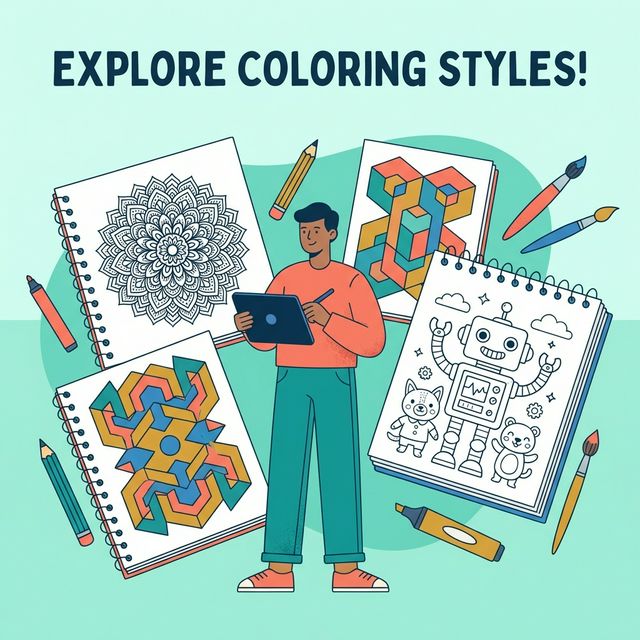
The Complete Guide to Coloring Page Styles
Mandalas, Geometric, Character and More
Coloring pages are not a single thing. Mandalas, character illustrations, zentangle patterns, botanical drawings, geometric designs, and comic-style art all require different tools, produce different effects, and appeal to different audiences. This is the complete reference.
The term "coloring page" covers an enormous range of visual styles, each with its own aesthetic, audience, difficulty profile, and best-use context. Whether you are choosing a book to buy, sourcing assets for a book you are publishing, or building a collection to offer customers, understanding the distinctions between styles helps you make better decisions.
Mandala Style
What it is: Circular designs with radial symmetry originating in Buddhist and Hindu traditions. The pattern radiates outward from a central point with repeating geometric or floral elements arranged around the center.
Complexity range: Wide. Simple mandalas (4–8 symmetry points, large sections) suit ages 8 and up. Complex mandalas (16+ symmetry points, microscopic detail) challenge experienced adult colorists.
Best tools: Fine-tip markers for small detailed sections, colored pencils for fill and blending, gel pens for metallic or glitter effects in the center.
Best for: Adult stress relief (research-backed), meditation practice, experienced colorists who want a satisfying technical challenge. The most popular single style in adult coloring.
Publisher note: Mandala books have the most consistent adult buyer intent of any coloring style. The search volume for "mandala coloring book" is enormous year-round.
Geometric and Abstract
What it is: Line art built from geometric shapes — triangles, hexagons, chevrons, diamonds, and their combinations — arranged into repeating or progressive patterns. Unlike mandalas, geometric designs are not necessarily circular and often fill the page in a grid or tessellating structure.
Complexity range: Medium to high. The shape boundaries are clear and regular, making it less frustrating to color neatly than organic illustrations, but the pattern density can be very high.
Best tools: Fine-tip markers produce the cleanest results in geometric work. Colored pencils work but leave more visible texture in the fill areas.
Best for: Adults who prefer structure and pattern over illustration, colorists interested in color theory (geometric grids are ideal for exploring color relationships), and anyone who finds organic illustration coloring too unpredictable.
Character and Cartoon
What it is: Illustrated characters — animals, people, fantasy creatures — drawn in a simplified, stylized style with bold outlines and expressive features. This is the dominant style in children's coloring books and appears in some adult books as well.
Complexity range: Wide, but the lower end of the range is lower than mandala or geometric. Simple character illustrations with minimal background detail are appropriate for ages 3 and up. Character-based books with complex scenes and background detail can engage adults.
Best tools: Crayons and broad colored pencils for young children. Fine-tip markers and colored pencils for older children and adults.
Best for: Children of all ages, gift coloring books where the character theme drives the purchase, and personalized coloring books where a character represents the recipient's interests.
Botanical and Nature
What it is: Detailed illustrations of flowers, plants, leaves, insects, birds, and natural scenes. Can range from simplified decorative botanicals to highly realistic scientific illustration style.
Complexity range: Medium to very high. The organic complexity of natural forms provides natural variation within a single illustration.
Best tools: Watercolor pencils with a damp brush for blended natural tones, colored pencils for layering, fine-tip markers for stem and vein detail.
Best for: Adult colorists who prefer organic forms over geometric structure, nature enthusiasts, and the gift market (botanical coloring books are the most consistently well-received adult coloring gift).
Zentangle and Doodle Patterns
What it is: Dense repetitive micro-patterns filling defined shapes or flowing freely across the page. Zentangle is a trademarked method but the term is widely used for any coloring page using similar dense pattern-within-pattern structure.
Complexity range: Uniformly high. Zentangle-style coloring pages are among the most time-intensive to color and are strictly adult territory.
Best tools: Fine-tip markers (0.3–0.5mm) are essential for the micro-pattern sections. Colored pencils cannot achieve the precision needed in the smallest pattern elements.
Best for: Experienced adult colorists who want the longest possible engagement time per page. A single complex zentangle page can absorb 4–8 hours of coloring.
Comic and Manga Style
What it is: Character illustration drawn in the visual language of comic books or manga — dynamic poses, expressive faces, panel-based or full-page compositions, action lines and speed effects.
Complexity range: Medium to high depending on background detail and pose complexity.
Best tools: Colored markers (Copics or similar) are the traditional tool for this style and produce the most authentic results. Colored pencils work but the style's origins are in marker-based coloring.
Best for: Tweens and teens, comic book and anime enthusiasts, and adult collectors who grew up with this visual language.
Architectural and Urban
What it is: Illustrations of buildings, cityscapes, interiors, and architectural details. Line-art style derived from technical drawing and travel sketching.
Complexity range: Medium to high. The regularity of architectural forms makes this more approachable than organic illustration at similar detail levels.
Best tools: Fine-tip markers for building outlines, colored pencils for material rendering (brick, wood, glass effects).
Best for: Adults with interest in architecture, travel, or urban environments. Strong gift potential for world travelers.
Choosing the Right Style
| If you want... | Choose |
|---|---|
| Maximum stress relief | Mandala or geometric |
| Creative flow and absorption | Botanical or zentangle |
| A gift for an adult | Botanical or fantasy character |
| A book for children under 7 | Character (simple) |
| A book for ages 8–12 | Character (complex) or simple mandala |
| Longest engagement per page | Zentangle |
| Most social media sharing potential | Botanical or zentangle |
Browse KikoPop Coloring Books by Style
Mandalas, botanical, character, and geometric collections. Filter by audience and complexity to find your match.
Browse by StyleBottom Line
The style is not just an aesthetic choice — it determines who the book is for, what tools work with it, how long a session lasts, and what benefit the coloring produces. Match the style to the intended coloring experience and the intended audience, and you will spend less time with the wrong book and more time actually coloring.