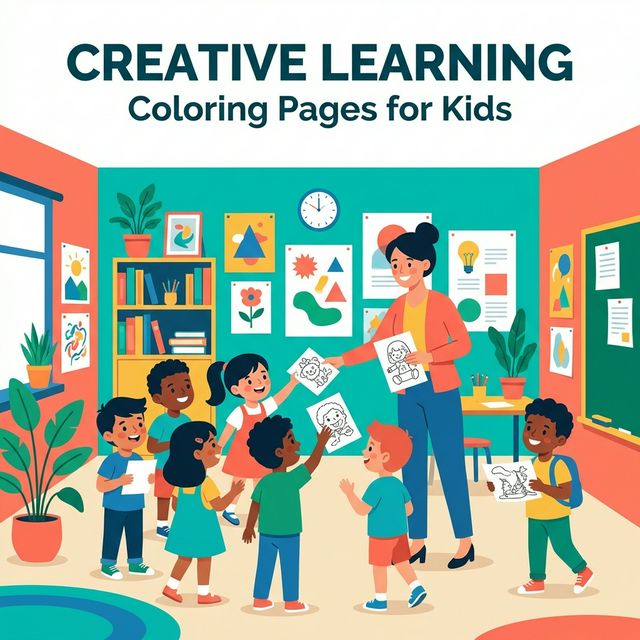
How to Use Coloring Pages in the Classroom
A Teacher's Activity Guide
Coloring pages in the classroom are often dismissed as filler. Used intentionally, they're one of the most versatile instructional tools available — supporting literacy, content learning, fine motor development, and classroom management simultaneously.
The criticism that coloring in classrooms is "mindless busy work" misses what's actually happening when children color with purpose. The issue isn't the activity — it's the lack of intentionality about how it's deployed. A coloring page handed out with no context or connection to learning is busy work. A coloring page used as a vocabulary anchor, a transition tool, a comprehension response, or a community-building activity is something else entirely.
This guide covers the specific classroom uses that deliver real instructional value, with practical implementation details for K-8 teachers.
Morning Work and Arrival Routines
The first 10 minutes of a school day are logistically complex — children arrive at different times, some need immediate adult support, and the class needs to settle before instruction can begin. A meaningful independent activity waiting on every desk solves this problem better than most alternatives.
Coloring pages work exceptionally well for morning work because they're genuinely engaging, they don't require any setup or explanation, they accommodate the full range of arrival times (a child who arrives at 8:00 can color for 15 minutes, a child who arrives at 8:12 can color for 3 minutes, and both have completed the activity), and they create a calm, focused atmosphere that carries into the opening of instruction.
For maximum instructional value, use morning work coloring pages that connect to current learning — a scene from a read-aloud you're doing, characters from a book in your current reading unit, vocabulary from your science or social studies unit. Children who color a page featuring a habitat you're studying arrive at the content discussion having already spent 10 minutes in visual contact with the key concepts.
Literacy Integration
Read-aloud response. After a picture book read-aloud, give children a coloring page featuring the main character or setting. Ask them to color the character the way they imagined them while listening — this makes visible the mental images children construct from text, which is a core comprehension skill. The coloring becomes an externalization of reading comprehension rather than a separate activity.
Vocabulary anchoring. For each new vocabulary word you introduce, pair it with a coloring page that depicts the concept. A child who has colored a "nocturnal" scene (owl, moon, night sky, sleeping animals) has a visual memory anchor for that word that's far more durable than a definition alone. This works especially well for abstract or unfamiliar concepts.
Sequence and retelling. Provide a series of coloring pages (3-4 scenes from a story in order) and ask children to color them in sequence, then use them as props for retelling the story to a partner. This combines sequencing, comprehension, and oral language skills in a single activity.
Science and Social Studies Integration
Coloring pages are underused in content area instruction despite being particularly well-suited to it. A few high-value applications:
Labeling activities. Provide a coloring page of a plant, animal, landform, or other content-area subject with blank label lines attached to specific features. Children color the image and complete the labels — combining fine motor engagement with content vocabulary practice. This beats a worksheet with a static diagram because the coloring element activates different cognitive engagement.
Life cycle and process sequencing. A set of 4 coloring pages showing stages of a butterfly life cycle, water cycle, or rock cycle gives children a tangible, colorable representation of a process. After coloring, children cut and sequence the stages and glue them into their science journals — a multi-step activity that produces a lasting reference artifact.
Cultural and historical contexts. For social studies units, coloring pages depicting historical scenes, traditional clothing, architectural styles, or cultural objects provide accessible, engaging entry points that are often more memorable than photographs or textbook images.
Transition Management
Transitions are where classroom time disappears. A clear, achievable task that children can pick up and put down during transition periods reduces transition time dramatically and gives early finishers something meaningful to do while waiting for classmates.
"Finish this page before we line up" is a more effective transition direction than "be ready in two minutes" because it gives children agency over the transition — they know exactly what they need to do and when they're done. Children who finish early have something to continue. Children who are slow can be redirected without conflict because the expectation is clear.
Early Finisher and Free Choice
Early finisher boxes stocked with coloring pages at graduated difficulty levels give advanced students a genuine challenge rather than busywork. A folder with "Quick Finish" pages (simple, large, low-detail) and "Challenge" pages (fine line, complex scenes, pattern-heavy) lets children self-select based on their available time and engagement level.
Free choice coloring during earned free time, indoor recess, or enrichment periods serves a different function: it provides genuine restoration. Unstructured coloring for pleasure — no assignment, no outcome, no expectation — has documented calming and focus-restoration effects. This is different from instructional coloring and should be offered separately, not collapsed with it.
Browse KikoPop Classroom Packs
Character packs with classroom printing rights included. Consistent art style across 10+ theme families. From $4.99 per pack.
Browse Classroom PacksCommunity Building
Two classroom coloring activities that build community in ways most other activities can't:
Collaborative coloring murals. Print the same background scene on 25-30 sheets — one per child. Each child colors their version independently. Display all versions together as a grid on the wall. The visual impact of seeing 25 interpretations of the same scene side by side makes visible the fact that every person in the class sees the world differently — a powerful lesson in perspective and community that doesn't require any instruction to land.
Classmate name tracing. In late Kindergarten or first grade, give each child a page with a classmate's name to trace. Collect them, sort them, and give each child the pages with their own name traced by their classmates — a tangible artifact of the class's relationship with each individual child that parents treasure.
Bottom Line
Coloring pages are as instructionally rich or as empty as the teacher makes them. Used intentionally — connected to current learning, deployed at the right time, with a clear purpose — they're one of the most versatile tools in the K-8 classroom. Used as filler, they're filler.
The strategies in this guide require no extra planning time beyond choosing a relevant page. The intellectual lift is in making the connection between the coloring activity and the instructional goal — and once you've done it once, it becomes a habit that transforms how you think about the tool.